+91 84849 90676
.cd78382e.png) info@artigenius.com
info@artigenius.com


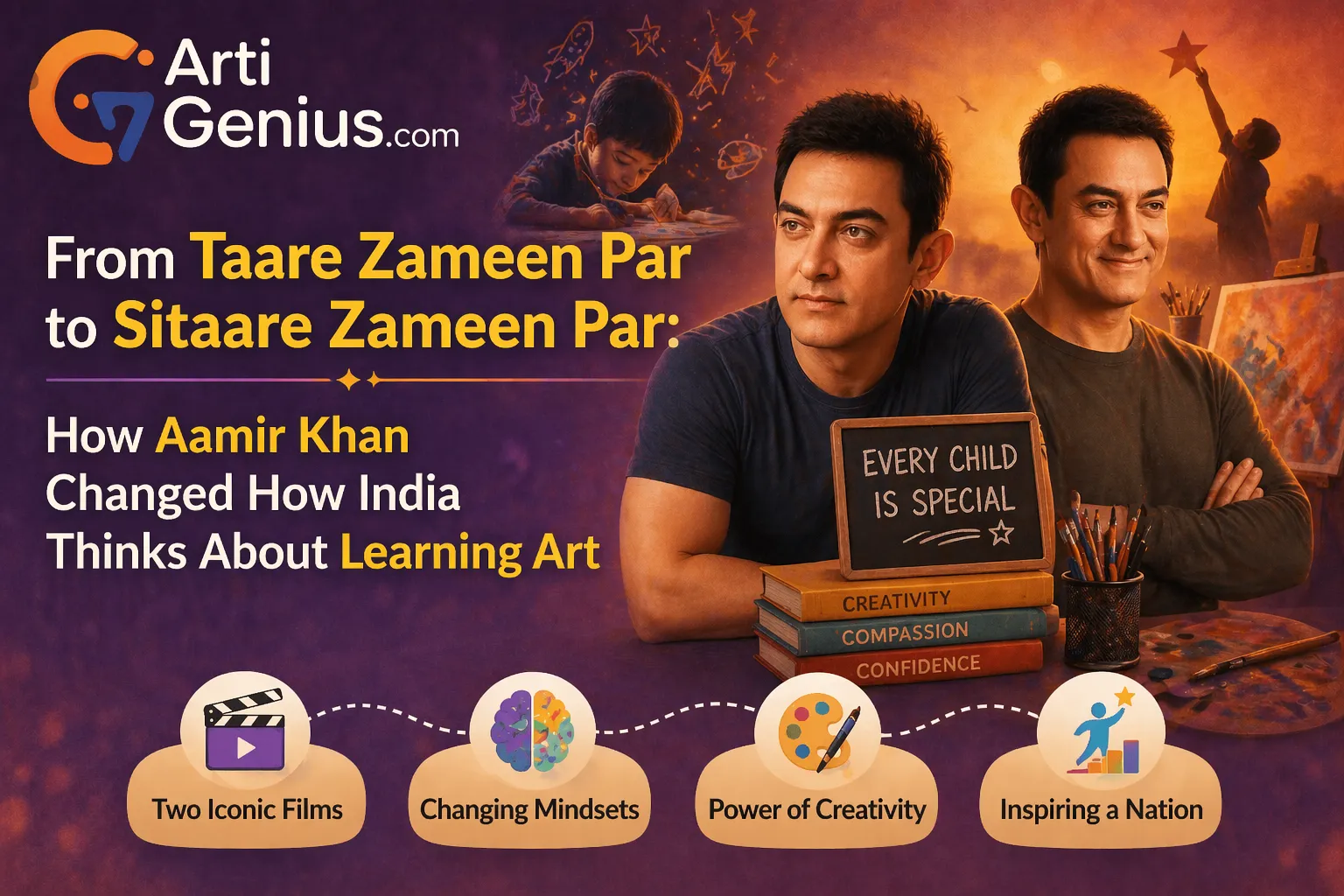
Think back to 2007. You were sitting in a dark cinema hall. A little boy named Ishaan was staring at his blank exam paper, tears streaming down his face — not because he was lazy or careless, but because no one had taken the time to understand how he saw the world.
That moment from Taare Zameen Par changed how millions of Indian parents, teachers, and students thought about learning. And art. Forever.
Now, nearly two decades later, Aamir Khan is back — this time with Sitaare Zameen Par (now streaming on SonyLIV), continuing the conversation with the same warmth and a fresh, important message: Every person learns differently, and every person deserves a chance to shine.
Whether you're a parent wondering if your child should try an art class, or an adult who was told "you're not creative enough" — this story is for you.
The Film That Made India Cry — And Think
Let's start at the beginning.
Taare Zameen Par is a 2007 Indian Hindi-language psychological drama produced and directed by Aamir Khan. It explores the life of Ishaan, an artistically gifted 8-year-old boy whose poor academic performance leads his parents to send him to a boarding school, where a new art teacher named Nikumbh (played by Aamir Khan) suspects that he is dyslexic and helps him overcome his reading disorder.
Simple plot. But the impact? Anything but.
Before the film, dyslexia was a little-known condition in India. Taare Zameen Par brought it into the national spotlight. Many parents and teachers realised that what they had dismissed as "laziness" or "stupidity" was actually a learning disability.
Think about that for a second. An entire country — a country of over a billion people — learned what dyslexia was because of a Bollywood film. That's not just cinema. That's social change.
Watch the iconic "Maa" scene from Taare Zameen Par: ( add youtube video and give credits)
What Nikumbh Taught Us About Teaching Art
Here's the part that doesn't get talked about enough.
Yes, Taare Zameen Par is a film about dyslexia. But it's also — at its core — a film about what a good art teacher can do for a child.
Aamir Khan's character Ram Shankar Nikumbh doesn't show up with a syllabus. He doesn't hand Ishaan a worksheet. He walks into the classroom and asks the children what they see, what they feel, what they imagine.
Unlike other teachers who follow definite norms in educating children, Nikumbh makes them think outside books, outside the four walls of the classroom, and paint their imaginations.
That's the real lesson hidden inside this film. Art education isn't about perfection. It's about expression.
For years, Indian classrooms treated art as the "free period subject" — something to fill time between Maths and Science. Taare Zameen Par told every parent, every school principal, every child: Art is not decoration. It is a discovery.
The film hints at a curious neurocognitive phenomenon — creativity in the midst of language disability, as exemplified in the lives of people like Leonardo da Vinci and Albert Einstein, both of whom demonstrated extraordinary creativity even though they were probably affected with developmental learning disorders.
(Source: Taare Zameen Par and Dyslexic Savants — Published in PubMed Central / National Institutes of Health, 2009)
So the next time someone says "my child isn't good at studies," ask yourself — are they perhaps good at something the classroom hasn't discovered yet?
---
Awards, Legacy, and Why It Still Matters in 2026
The film wasn't just loved by audiences. It was celebrated everywhere.
At the 55th National Film Awards, Taare Zameen Par won three awards: Best Film on Family Welfare, Best Lyrics (Prasoon Joshi for "Maa"), and Best Male Playback Singer (Shankar Mahadevan for "Maa"). At the 53rd Filmfare Awards, it received 11 nominations and won a leading 5 awards, including Best Film and Best Director. [Source - Wikipedia](https://en.wikipedia.org/wiki/Taare_Zameen_Par)
But more meaningful than any trophy was what happened in schools and homes across India. Its impact still reverberates through classrooms and homes across India — 15 years later.
(https://www.airtel.in/blog/entertainment/beyond-the-screen-how-taare-zameen-par-reshaped-indian-education-and-parenting/)
Organisations like the Dyslexia Association of India saw increased awareness and enrolments after the film. Parents who never knew the word "dyslexia" were suddenly asking their children's schools the right questions.
That's what one film, made with honesty and care, can do.
Watch Taare Zameen Par Official Trailer:(add youtube video give credits)
*(Source: Aamir Khan Productions Official)*
---
Fast Forward to 2025 — Enter Sitaare Zameen Par
Now let's talk about the film that's currently trending on SonyLIV and why it matters to you just as much.
Sitaare Zameen Par (2025) is the spiritual successor to Taare Zameen Par. While the earlier film focused on dyslexia and education, Sitaare Zameen Par broadened the conversation to include neurodiversity and social inclusion. The film carries the message: "Every individual has unique strengths, and society must learn to recognize and celebrate those differences."
This time, the story follows Gulshan Arora — a hot-headed, disgraced basketball coach — who is ordered by a court to train a team of neurodivergent adults. He goes in reluctantly. He comes out transformed.
The film doesn't use stereotypes. It shows neurodivergent people as capable adults — each with a unique personality, strong emotions, and dreams worth fighting for. Instead of pity, the film offers respect.
The first half shows Aamir Khan teaching the team, and in a beautiful twist, the second half shows the team becoming his teachers.
That line says everything.
Watch Sitaare Zameen Par Official Trailer: (add youtube video)
[
*(Source: Aamir Khan Talkies — Official YouTube Channel)*
---
What Changed Between 2007 and 2025?
Two films. Eighteen years apart. The same filmmaker. The same heart. But a much bigger, more urgent message.
In 2007, Aamir Khan was asking India: "Can you see this child?"
In 2025, he was asking: "Can you see this adult?"
Darsheel Safary — the child who played Ishaan in Taare Zameen Par— described watching Sitaare Zameen Par as making his heart "fuller, softer and happier." Cricket legend Sachin Tendulkar commended its unifying message, and actor Mahesh Babu said it will "make you laugh, cry and clap."
But it's not just about a sequel. It's about a shift in how India sees creativity, learning, and talent.
Here's what that shift looks like:
Make it
Then (2007)
My child failed art class
Art is for 'talented' kids
Learning disability = burden
Studio classes only
Now (2025–2026)
Art is for every child
My child expresses differently
Neurodiversity = different strength
Online art classes from home
---
The Real Question These Films Ask YOU
Both films, at their heart, ask the same uncomfortable question: Are we teaching children — or are we just grading them?
Taare Zameen Par does not suggest that artistic talents should be prioritised over traditional academics. It emphasises the importance of recognising and nurturing each child's unique abilities alongside academic development.
That's the key. It's not "art OR studies." It's "art AND studies."
And here's what research actually says about kids who learn art:
- Painting builds focus and attention to detail that transfers to all subjects
- Dance develops spatial awareness and coordination that aids in mathematics
- Music trains pattern recognition— the same cognitive skill used in language learning
- Creative expression reduces anxiety and stress in school-going children
The Artful Parent — Music as an Art Prompt, April 2026
---
The 2026 Difference: You Don't Have to Wait for a Nikumbh to Walk Into Your School
Here's something Ishaan in 2007 didn't have — and your child in 2026 does.
Online art and dance classes.
In Taare Zameen Par, Ishaan's transformation required a specific teacher, in a specific school, at a specific time. That was one boy's lucky moment.
Today, online classes allow you to pause the video, watch at a slower speed, and rewatch as many times as you want — which improves learning and provides a feeling of safety and control.
Top Four Reasons to Take an Online Art Course
Your child doesn't have to sit in a rush-hour auto to reach a studio in Pune. They don't have to wait for the "right teacher" to appear in their school. They can log in from their bedroom, in their own time, with a patient instructor — and start discovering what they're capable of.
That is the Nikumbh experience, available to every child — regardless of whether they live in Koregaon Park or Kothrud, Hadapsar or Hinjewadi.
Online art classes are trending because they help students and guides build relationships on a personal level. The one-on-one meetings also allow artists to gain more attention and personalised recommendations from their art teachers.
---
What Both Films Remind Every Parent in Pune (and India)
Before we wrap up, let's bring this back to where it started — that little boy, staring at a blank exam paper.
Ishaan wasn't failing. He was waiting for someone to ask him the right question.
Your child might be doing the same.
Whether it's painting, dancing, music, or even just doodling in the margins of a notebook — that creative impulse is not a distraction. It's a signal.
Neurodivergence isn't a flaw — it's a different way of experiencing the world. We must move beyond awareness and toward acceptance, inclusion, and action. It's time we build a world where every mind is valued, every voice is heard, and no one is left behind for simply thinking differently.
Aamir Khan didn't just make two films. He started a conversation that India desperately needed — twice, eighteen years apart.
And the conversation isn't over yet.
---
Ready to Find Your Child's Inner Ishaan?
At Artigenius, we believe every child has a star inside them waiting to be discovered — just like Ishaan.
Our online dance classes and online painting classes(add dance classes link to the online dance classes word) in Pune are designed to be:
- Flexible — learn from home, at your own pace
- Beginner-friendly — zero experience needed
- Structured — guided by experienced, patient teachers
- Affordable — starting at just ₹999/month
Join a FREE Trial Painting Class Book a FREE Trial Dance Class
Because every child deserves a Nikumbh moment — and now, they don't have to wait for one.
---
Sources & Credits
All information in this article has been sourced from credible, publicly available references.